top of page



Exceed In English Ltd
Exceed in English Ltd
Safeguarding Under-18s and Vulnerable Adults Policy
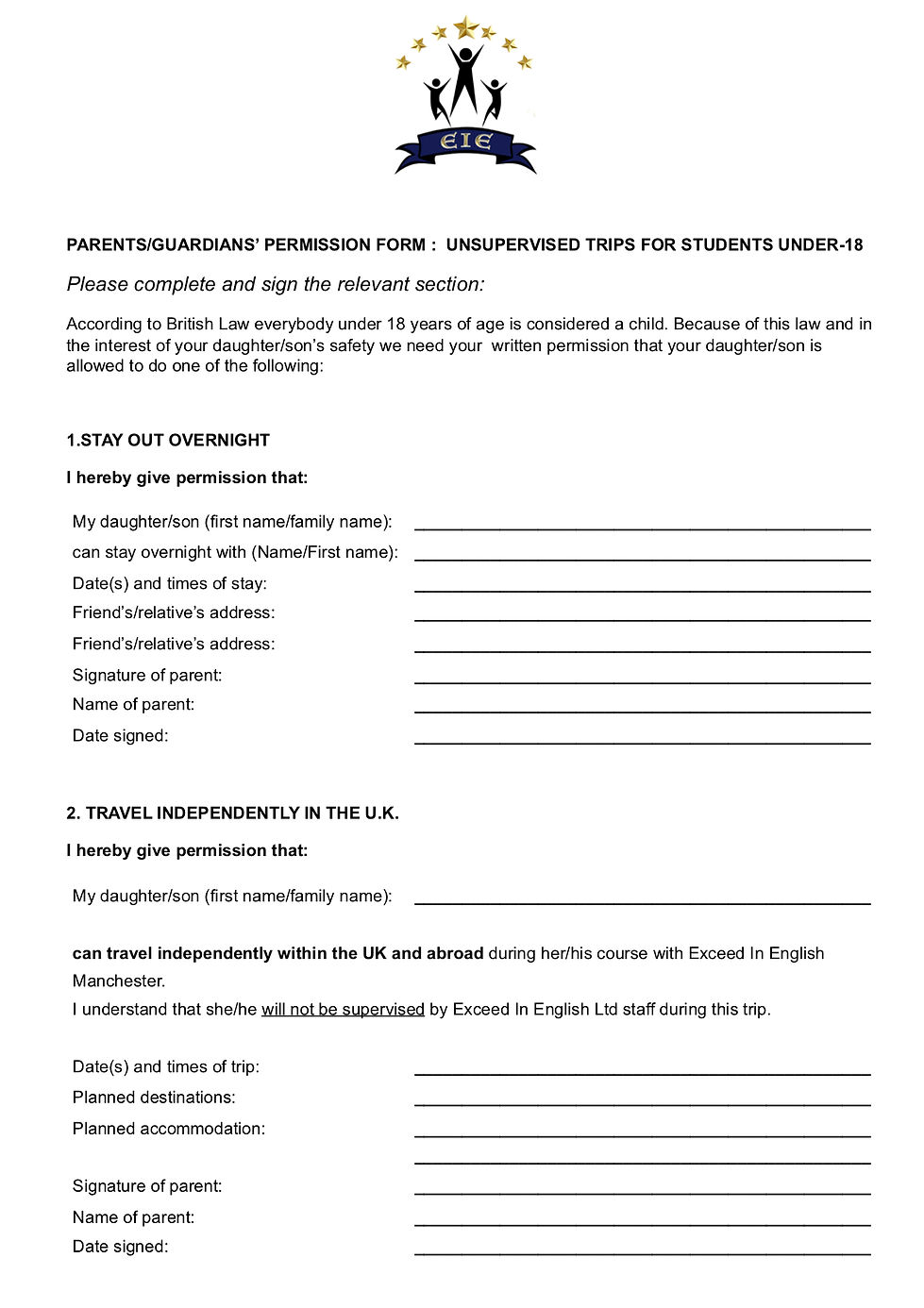
Parents of under 18's who want their child to attend Exceed In English must complete this form
1. Introduction
The guidance and procedures in this document are designed to help safeguard young people and reduce the risk of teaching, social programme, pastoral or administrative staff being falsely accused of improper or unprofessional conduct.
This guidance cannot provide a complete checklist of what is, or is not, appropriate behaviour for staff. It does highlight, however, behaviour that is illegal, inappropriate or inadvisable. It also gives explanations for the guidance, in order to help staff reflect on their roles and be able to respond effectively in situations not covered in the sections below.
2. Key Definitions
In this document, the words "children", "young people", “students” and "pupils" all refer to children under the age of 18 years.
The term "allegation" means any information that suggests an adult has caused or may cause hurt or harm to a child or young person.
3. Underpinning Principles
-
The welfare of the child is paramount (Children Act 1989).
-
Staff are responsible for their own actions and behaviour and should avoid any conduct which would lead any reasonable person to question their motivation and intentions.
-
Staff should work, and be seen to work, in an open and transparent way.
-
Staff should discuss and/or take advice promptly from their manager or another senior member of staff over any incident which may give rise to concern.
-
Records should be made of any such incident and of decisions made/further actions agreed in accordance with the school procedure for record-keeping.
-
Staff should apply the same professional standards with students regardless of gender or sexuality.
-
All staff should know the name of their designated person for child protection and understand their responsibilities to safeguard and protect children and young people. This will be explained in staff induction meetings.
-
Staff should be aware that breaches of the law and other professional guidelines could result in criminal or disciplinary action being taken against them.
4. Duty of Care
Teachers and other staff are accountable for the way in which they exercise authority, manage risk, use resources and protect pupils from discrimination and avoidable harm.
All staff have a duty to keep young people safe and to protect them from physical and emotional harm. This duty is partially imposed by the Health and Safety at Work Act 1974.
5. Exercising Professional Judgement
Where no specific guidance exists staff are expected to make judgements about their behaviour in order to secure the best interests and welfare of the children in their charge and in so doing, will be seen to be acting reasonably.
However, in the case of unusual situations such as accidents, threats from students or major misunderstandings with them, staff should always write down what happened and then discuss it with a manager to ensure that the safest practices are employed and to reduce the risk of actions being misinterpreted.
6. Power and Positions of Trust
Staff are in a position of trust with young people and have a responsibility to ensure that they do not use their position for personal advantage or gratification. Staff should not use their power to intimidate, threaten, coerce or undermine students.
Wherever possible, staff should avoid behaviour which might be misinterpreted by others and report to senior staff and record any incident with this potential.
7. Confidentiality
In some circumstances, staff may be given additional highly sensitive or private information. They should never use confidential or personal information about a pupil or her/his family for their own, or others’ advantage (including that of partners, friends, relatives or other organisations) and such information should be treated in a discreet and confidential manner.
If staff are in any doubt about whether to share or keep information confidential, they should seek advice from a senior member of staff.
When a member of staff may be expected to share confidential information about a child, for example when abuse is alleged or suspected, individuals have a duty to pass information on without delay, but only on a need-to-know basis.
8. Propriety and Behaviour
Staff should not behave in a manner which would lead any reasonable person to question their suitability to work with children or act as a role model.
Therefore, staff must not, for example:
-
make sexual remarks to a pupil (including by email, text messages, phone or letter);
-
discuss their own sexual relationships with, or in the presence of, pupils;
-
discuss a pupil's sexual relationships (except where there is a specific welfare issue).
9. Dress and Appearance
When in contact with students, staff should ensure they are dressed decently, safely and appropriately for the tasks they undertake. Those who dress or appear in a manner which could be considered as offensive, revealing or provocative could leave themselves vulnerable to criticism or allegation.
10. Gifts
Staff should not accept any gift that might be construed as a bribe by others, or lead the giver to expect preferential treatment.
Similarly, it is inadvisable to give personal gifts to pupils. This could be misinterpreted as a gesture either to bribe, or single out the young person. It might be perceived that a 'favour' of some kind is expected in return.
Any reward given to a young person should be part of an agreed reward system and not based on favouritism.
11. Infatuations
It is not uncommon for pupils to be strongly attracted to a member of staff and/or develop an infatuation. All such situations should be responded to sensitively, to maintain the dignity of all concerned. Staff should also be aware that these circumstances always carry a high risk of words or actions being misinterpreted and of allegations being made.
A member of staff who becomes aware that a pupil may be infatuated with them or a colleague should discuss this at the earliest opportunity with a senior colleague so that appropriate action can be taken to avoid hurt and distress for all concerned.
12. Social Contact
Staff should not establish or seek to establish social contact outside the classroom with pupils for the purpose of securing a friendship. Even if a young person seeks to establish social contact, the member of staff should exercise her/his professional judgement in making a response and be aware that such social contact could be misconstrued.
Staff should not give their personal details, such as home/mobile phone number, home or e-mail address, to pupils.
13. Physical Contact – General Principles
In general, it is advisable to avoid physical contact with students.
However, if contact becomes necessary, this should be in response to their needs at the time, of limited duration and appropriate given their age, stage of development, gender, ethnicity and background. Appropriate physical contact in schools may occur most often with younger pupils.
Staff should be aware that even well-intentioned physical contact may be misconstrued by the child or an observer, so:
-
contact should never be secretive;
-
staff should never indulge in horseplay or tickling;
-
staff should always be prepared to explain actions;
-
staff must accept that all physical contact is open to scrutiny.
It should be recognised that a number of children who have suffered neglect or abuse may be extremely needy and seek out inappropriate physical contact. In such circumstances staff should deter the child sensitively by helping them to understand the importance of personal boundaries. Staff should always record and report serious incidents of contact whether by staff member to student or vice versa.
14. Physical Contact - PE and other activities which require physical contact
Some staff, for example, those who teach PE and games, will on occasions have to initiate physical contact with pupils in order to support a child so they can perform a task safely, to demonstrate the use of a particular piece of equipment/instrument or assist them with an exercise. This should be done with the pupil's agreement.
Contact under these circumstances should be for the minimum time necessary to complete the activity and take place in an open environment. If possible, staff should consider using alternatives to physical contact with students, e.g. by demonstrating an action using another member of staff.
15. Physical Contact - Showers and Changing
If staff members are required to supervise students. Staff should always tell a manager when and how they offered comfort to a distressed child and record situations which may give rise to concern.
16. Physical Contact - Pupils in Distress
There may be rare occasions when a distressed pupil needs comfort and reassurance. This may include age-appropriate physical contact. Staff should remain self-aware at all times in order that their contact is not threatening, intrusive or subject to misinterpretation. If at all possible, such contact should be given in the presence of another member of staff.
17. Physical Contact - Care, Control and Physical Intervention
The circumstances in which staff can intervene with a pupil are covered by the 1996 Education Act. Staff may legitimately intervene to prevent a pupil from committing a criminal offence, injuring themselves or others or causing damage to property.
When physical intervention is necessary, staff should remember the health and safety of themselves and the rest of the students in the group.
The use of unwarranted physical force is likely to constitute a criminal offence, so staff should:
-
try to defuse situations before they escalate
-
call or send a student for assistance when necessary
-
use minimum force for the shortest period necessary
-
adhere to the school’s behaviour management policy
In all cases where physical intervention is deemed necessary, details of the incident and subsequent actions should be written down and reported to senior managers.
18. Behaviour Management
Corporal punishment is unlawful in all schools. Equally, staff should not use any form of degrading treatment to punish a pupil. In addition, the use of demeaning or insensitive comments towards pupils is not acceptable in any situation.
19. Sexual Contact with Young People
According to the Health and Safety at Work Act 1974, where a person aged 18 or over is in a position of trust with a child under 18, it is an offence for that person to engage in sexual activity with or in the presence of that child, or to cause or incite that child to engage in or watch sexual activity.
Therefore any sexual behaviour by a member of staff with or towards a child or young person in their care is both inappropriate and illegal, regardless of whether or not the child or young person consents or whether they are aware of what is happening or not.
The sexual activity referred to does not just involve physical contact, but also non-contact activities, such as causing children to engage in or watch sexual activity or the production of pornographic material.
While praise for effort and achievement is a normal part of staff-student relationships, staff should be aware of the possibility that conferring excessive special attention and favour upon a child could be construed as being part of a 'grooming' process. This is where an adult attempts to gain the trust of a child and manipulates that relationship so sexual abuse can take place.
20. One-to-One Situations
Staff working in one-to-one situations with children and young people (for example, while doing speaking exam practice) may be more vulnerable to allegations.
Teachers and others should recognise this possibility and plan and conduct such meetings accordingly.
Staff should:
-
try to avoid one-to-one situations if possible;
-
avoid meetings with pupils in secluded areas of school;
-
ensure there is visual access and/or an open door in one-to-one situations;
-
inform other staff of the meeting beforehand, assessing the need to have them present or close by;
-
avoid use of 'engaged' or equivalent signs wherever possible, since they may create an opportunity for secrecy or the interpretation of secrecy;
-
always report any situation where a child becomes distressed or angry to a senior colleague;
-
consider the needs and circumstances of the child/children involved.
21. Transporting Children
In certain situations e.g. out of school activities, staff may agree to transport children. A designated member of staff should be appointed to plan and provide oversight of all transporting arrangements and respond to any difficulties that may arise.
Staff should not use their own vehicles for transporting children unless they have informed their own vehicle insurance company that they are using their own vehicle for occasional business purposes.
When using school vehicles, staff should ensure that their behaviour is safe and that the transport arrangements ensure vehicle, passenger and driver safety. For example, they should ensure that the vehicle meets all legal requirements, is roadworthy and appropriately insured, that students are wearing seatbelts at all times and that the maximum capacity is not exceeded. Wherever possible and practicable, it is advisable that students are transported with at least one adult additional to the driver, acting as an escort.
When transporting children, staff should try to avoid being alone with them for longer than necessary. They should also ensure that a senior member of staff is informed before and after children are transported on unscheduled journeys, e.g. when students cannot be collected by host families. When relevant, staff should be aware that the safety and welfare of students is their responsibility until they are safely passed over to a parent/carer.
22. Educational Visits and After School Activities
Staff should take particular care when supervising pupils in the less formal atmosphere of a residential setting or after-school activity.
During school activities that take place off the school site or out of school hours, a more relaxed discipline or informal dress and language code may be acceptable. However, staff remain in a position of trust and need to ensure that their behaviour cannot be interpreted as seeking to establish an inappropriate relationship or friendship.
Staff should:
-
always have another adult present in out-of-school activities, where possible;
-
ensure they have read the risk assessment for the activity and other relevant documents (and in the absence of a risk assessment, do their own);
-
ensure that their behaviour remains professional at all times.
23. First Aid and Administration of Medication
All staff should be aware of the identity of trained first aiders/appointed persons on school and residential sites. Staff should receive appropriate training before administering first aid or medication.
Each customer application contains questions asking for details of any medical conditions we should be aware of. Should an application for an U18 contain information on medical conditions, the staff member responsible for the application must discuss with the school Principal (or other Exceed In English senior staff, if absent) who will assess the need for a written medical care plan to be put into place before arrival. It will also be necessary for those senior staff to agree with the staff member responsible for the application that it is possible to cater for the condition(s) in question before the student is accepted.
A first step will normally be to email the parents/agent the ‘Medicine and medical condition further information request form’ kept in the Admin Manual on the school’s Admin drive. This information will help the school to form any Medical Care plan document. The plan will need to be agreed in advance with the school, hosts, or those adults responsible for accommodation during the student’s stay, and parents/legal guardians.
Pupils may need medication during school hours. In circumstances where children need medication regularly, staff must consult the student’s medical care plan. With the permission of parents, the children should be encouraged to administer the medication themselves. Where students receive medication under staff supervision, each event must be recorded in the School medication record book kept at each site.
If a member of staff is concerned or uncertain about the amount or type of medication being given to a pupil, this should be discussed with the appropriate senior colleague at the earliest opportunity. When administering first aid, wherever possible, staff should ensure that another adult is present, or aware of the action being taken. After administering first aid, the first aider should record the event in the accident book and inform senior staff, so that they can contact the group leader and, if necessary, parents. Accident book records are confidential so give these immediately on completion to the staff member in charge of Health and Safety.
24. Intimate Care
All children have a right to safety, privacy and dignity when contact of an intimate nature is required (for example assisting with toileting or removing wet/soiled clothing). It is envisaged that this will generally only apply to young children.
Children should be encouraged to act as independently as possible and to undertake as much of their own personal care as is practicable. When assistance is required, staff should ensure that another appropriate adult is in the vicinity and is aware of the task to be undertaken. Staff should also explain to the child what is happening.
25. Alcohol, smoking and drug use
U18s are not permitted to drink alcohol or use any non-prescribed drugs, including ‘legal highs’. Adults must not supply alcohol or cigarettes to U18 students and they must avoid promoting irresponsible attitudes towards alcohol, smoking and drug use through what they say and do.
Adults in a host family setting should exercise discretion when consuming alcohol. They must not be inebriated in front of U18s and must remain capable of dealing with an emergency or first aid incident at all times.
Adults must ensure that they smoke in a discreet manner away from U18s and that no smoking takes place in vehicles transporting U18s.
26. Curriculum
When selecting topics, teaching materials and activities, care should be taken to ensure that they are appropriate to the levels of maturity, personalities and cultures of the students in the class and that they cannot be misinterpreted. Care should be taken when discussing sensitive topics such as violence or politics. If in doubt about the appropriateness of topics, materials or activities, staff should seek the advice of a senior member of the teaching staff.
Staff should not enter into or encourage inappropriate or offensive discussion about sexual activity.
27. Photography, Videos and other Creative Arts
Many school activities involve recording images. Staff need to be aware of the potential for these images to be misused for pornographic or 'grooming' purposes. Children who have been previously abused in this way may feel threatened by the use of photography, filming etc. in the teaching environment. Staff should remain sensitive to any children who appear uncomfortable and should recognise the potential for misinterpretation.
Using images of children for publicity purposes will require the consent of the individual concerned and their legal guardians. Images should not be displayed on websites, in publications or in a public place without such consent. The definition of a public place includes areas where visitors to the school have access.
When recording images the following guidance should be followed:
-
staff should be clear about the purpose of the images and what will happen to them after the activity/lesson;
-
staff should ensure that a senior member of staff is aware when, where and why images are being created;
-
staff should be able to justify images of children in their possession and ensure that all images are available for scrutiny;
-
staff should avoid making images in one-to-one situations;
-
if a photograph is displayed publicly, avoid naming the pupil;
-
if the pupil is named publicly, avoid using their photograph;
-
senior staff should establish whether images used for publicity purposes will be retained for further use;
-
images should be securely stored and used only by those authorised to do so.
28. Internet Use
Using school time or equipment to access any inappropriate or indecent material, including adult pornography, is unacceptable. Staff should be careful not to access inappropriate content (e.g. emails, websites) in front of students.
Whether at work or at home, accessing child pornography or indecent images of children on the internet, and making, storing or disseminating such material, is illegal and, if proven, will invariably lead to the individual being barred from work with children and young people.
Staff should not have contact with U18s online, except through formats which are sanctioned and scrutinised by the School, e.g. emailing homework to a teacher’s school email address or responding to a message from an U18 on the School’s Facebook page. If teachers create platforms for sharing documents with U18 students, they must send access details to the Designated Safeguarding Person so that these platforms can be scrutinised at any time.
29. Whistleblowing
Whistleblowing is the mechanism by which staff can voice their serious concerns, made in good faith, without fear of repercussion, as described by the Public Interest Disclosure Act 1998.
Where the welfare of children may be at risk, staff should bring matters of concern to the attention of senior management and if necessary, relevant external agencies. Concerns may include any behaviour by other colleagues that raises concern.
30. Sharing Concerns and Recording Incidents
All staff should know the name of the school's designated member of staff for child protection, or the equivalent individual, and know and follow relevant child protection policy and procedures. All Exceed In English staff have a duty to record and report any child protection concerns to their designated person for child protection.
In the event of an incident occurring, which may result in an action being misinterpreted and/or an allegation being made against a member of staff, the relevant information should be clearly and promptly recorded and reported to senior staff. Early discussion with a parent or carer could avoid any misunderstanding.
Members of staff should feel able to discuss with their line manager any difficulties or problems that may affect their relationship with pupils so that appropriate support can be provided or action can be taken.
EXTRA GUIDELINES FOR HOST FAMILIES
31. Host families being in a position of trust
Anyone who looks after someone i.e. is caring for, training, supervising or is in sole charge of such persons under 18 is considered to be in a position of trust. This means that for anyone looking after an U18 either of the following can constitute a criminal offence:
-
engaging in sexual activity with or in front of U18s;
-
encouraging U18s to engage in or watch sexual activity.
The above paragraph has obvious implications for the behaviour of the care givers in host families. Hosts should therefore avoid any behaviour which could be misinterpreted by U18s and lead to allegations being made.
32. Supervision of U18s by people other than the main caregivers
Although students under 16 should not be left unsupervised, the main care providers in a host family might ask other adult family members to be in sole charge of U18 students for short periods. Such a period might be for a few hours, but should never be overnight. If the caregivers in a host family cannot be present overnight, the hosts must inform the School as early as possible, so that alternative accommodation can be found.
If other family members are in sole charge of U18 students, this places them in positions of trust and the behaviour outlined in italics in the section above would be inappropriate and perhaps illegal while the student is in the care of that host family.
33. One-to-one situations
While host family members may be in one-to-one situations with U18s, they should ensure that their interactions are appropriate and justified and that any undue proximity is avoided, so that U18s feel comfortable and hosts are not made vulnerable to allegations.
34. Private fostering arrangements
If a child under the age of 16 (under 18 if disabled) is cared for 28 days or more by someone who is not their parent or a close relative this is deemed a private fostering arrangement and Children's Social Care for the relevant area has to be notified. If this is the case for a host family, the School will liaise with them to ensure that Social Care are informed.
35. Medical conditions/learning difficulties
When registering their children as students, parents are required to inform the School about any medical conditions or learning difficulties that their children have. The School will pass on this information to hosts before the student’s arrival, so if hosts discover that their student has any conditions or difficulties that the School has not informed them about, hosts must tell the School as soon as possible.
Before a student’s arrival, the School will draw up a care plan for that student, if needed. This will be discussed and agreed with the host family before the student arrives. Once again, if a student has medical or care needs that are not part of the agreed care plan, hosts must inform the School as soon as possible.
If students need any medical attention from a healthcare professional, they should be accompanied by a responsible adult, which will normally be a host caregiver outside school hours. Hosts must pass on details of the medical attention required to the School, where the student has given their consent to this information being shared.
36. Student privacy
Students are entitled to reasonable levels of privacy. Except in an emergency, when entering the student’s bedroom via a closed door, hosts should ‘double knock’, i.e. knock, wait and knock again before entering the room, in case the student is undressed.
Hosts must not enter a bathroom or toilet when it is occupied by a student and hosts must be appropriately covered at all times when students are present.
Students must not have other people in their bedrooms, except with the permission of the host family.
It is, of course, appropriate in the absence of the student for hosts for enter a student’s room in order to clean it and check on the condition of its contents. If hosts find inappropriate objects in the student’s room, then this should be reported to the School.
If hosts suspect theft or that students possess inappropriate objects or substances, then it may be necessary for hosts to search student’s personal property. Whenever possible, this should be done after prior consultation with the School.
There are legal restrictions regarding searching an U18, so unless a host believes that there may a serious risk of harm to someone, they should consult the School before searching a student.
In an emergency it may be best to phone the local police to get their advice on the legality of and appropriate conduct when searching a student.
37. Absences from host families
Hosts must ensure that U18 students have the hosts’ phone number recorded and kept on their person at all times. (Please ask students to keep an additional paper copy of phone numbers, in case their mobile phone runs out of battery.) Hosts should, of course, also record the mobile number of their student.
If students are unexpectedly absent, especially after curfew, host families should try to contact the student by mobile and, if unsuccessful, phone the school during working hours, or the emergency phone outside school hours. However, hosts should wait for up to 30 minutes after curfew, depending on the age of the student, before phoning the school emergency phone in the evening.
If it is not possible to contact the emergency phone after repeated attempts, then hosts should consider phoning the police and following their guidance. Please also inform the School about students who repeatedly fail to meet curfew times.
38. Activities not supervised by School staff: assessing the risks
As part of their duty of care, hosts need to consider the level of risk for a supervised/unsupervised activity for their individual student before deciding on its appropriateness and the level of supervision required, e.g. going to an activities centre with the host family or attending Manchester events with other students. The level of risk will depend on factors such as the student’s age, gender, emotional maturity, life experience, physical abilities, attitude to risk and awareness of UK culture and norms.
The School uses formal risk assessments for their activities and while this is not expected for host families, they should nevertheless consider a number of questions before doing activities with their U18s or giving them permission to do activities with limited or no host family supervision. Some of these questions are often most relevant for 16/17 year-olds, who may consider themselves adults, and therefore may exhibit more risk-taking behaviour.
All activities
1. Can the student cross the road safely?
2. Has the student secured their belongings to minimise the risk of pickpocketing or mugging?
3. Does the student have a suitable level of English/physical ability /confidence to do an activity safely?
4. Does the student know what to do or who to contact if something goes wrong? (This could be their hosts, the school emergency phone or the emergency services.)
Supervised activities
1. If separated from their hosts, does the student know what to do?
Unsupervised activities
2. Does the student know how to travel to and from a particular venue safely and what time to allow to return home by curfew time?
3. Is the student aware of how to stay safe when out in public and which local areas to avoid at certain times?
4. Does the student understand UK social norms and/or UK law relevant to a particular activity?
5. Does the student understand UK law relevant to a particular activity?
6. Is the student going to be with a friend at all times? If not, is it safe for them to be alone?
7. Is the student aware that sanctions may be applied by the hosts or the School for unacceptable behaviour?
8. Does the student have access to food, water and any medication required?
39. Transporting students in host family cars
Please remember, as per the Hosting Terms and Conditions, hosts must inform their motor insurers in advance that they intend to use their car for occasional business purposes if transporting Exceed In English Ltd students. Exceed In English Ltd cannot be held responsible for any damage or injury.
All U18s must wear seat belts in vehicles.
40. Trips outside Manchester not under host family supervision
Students must get permission from the School before they go on trips outside Manchester unsupervised by host families or the School. If a student announces their intention to go on a trip, hosts should tell them to contact the School to obtain permission for this. The School will have to obtain written permission from the student’s parents/guardians and must in addition be satisfied that the trip is appropriate and safe. The School will then contact the host family to confirm that the student can go on the trip.
41. IT and social networks
Supervision of IT use in the host family home should be age-appropriate. Hosts should ensure that, where possible, family IT devices and/or routers have parental controls activated, although some students may be adept at getting round these controls. Hosts should also ensure that students cannot access any inappropriate material stored on the host family’s IT devices.
If hosts become aware that students are accessing inappropriate content (e.g. extremist websites), this is a safeguarding issue and they should contact the School to discuss the situation. Similarly, if students are using IT at inappropriate times (e.g. playing games late into the night), they should discuss this with the student and, if necessary, with the School.
42. Parental agreement
Hosts should be aware of the agreement that all parents must discuss with their children and sign before their children start their courses at Exceed In English Ltd Manchester. The agreement contains essential information on curfew, behaviour and UK law.
bottom of page